

Learning is Really About Allowing
Twelve truths about I've learned over time

If you asked me to define myself with one word, I wouldn’t say “artist.” I’d say “student.” Because that’s really what I am—a student of life. I love to learn.
I also think I’m good at it.
That might sound goofy, to think of yourself as “good at learning.” But I’ve noticed that once most people leave school, they don’t really understand what’s involved in learning something deeply because the school structure is gone.
But the learning structure still exists, even if the school itself isn’t there.
Just as understanding the creative process allows you to make more art, understanding the learning process better can help you learn more deeply.
Knowing how learning works is like a scaffolding that holds me up as I clutch my notes and climb a new set of narrow rickety stairs skyward to the unknown.
Because I’m neck deep in learning something new right now, I am very conscious of how I use my knowledge of the learning process to help myself learn.
Here's what I know.
Twelve Truths of Learning Well
Learning is about allowing.
I learn exactly what I want to learn in the order I want to learn it (even if that’s not the “logical” order.) That means I often don’t start at the beginning; instead, I start at my point of interest. It also means that sometimes I end up having to backtrack and return to the beginning—but that’s okay, because I’m now willing to be there.Perfectionism is a form of self-violence that sabotages learning.
Perfectionism does not allow allowing. But to learn, you must allow yourself to try something and be bad at it. Allow the evidence of your bad work to exist on your work table even if someone might see it. Allow yourself to be confused for an extended period of time—without mistaking that for being a permanent state or for indicating an innate lack of ability.
Learning is, therefore, the opposite of trying to be perfect. (Perfectionism is also not “holding yourself to a high standard.” It’s holding yourself to an impossible standard.)Know why you want to learn something.
I learn particular techniques to further specific artistic goals, not just because I think they’re cool or because I saw that another artist made something great by using them. And throughout the process, I’m always asking myself: What do I want to say with these materials—and why? How does knowing how to do this serve my practice?
In fairness, sometimes a new technique is just fun to learn and I love that too. That’s what taking a little workshop is for. For me, taking a workshop is like meeting someone new—it’s a fun and interesting way to spend a day, but not deep learning. It is, however, an efficient way to find out if I want to know that information, skill, or technique better—and really learn it—or not.I know how I learn and I honor that.
I need to see the big picture before I can start something. It’s the way I think. When I take online classes where they slowly drip the content out, I can’t really start the exercises until I see the whole picture. So usually, I just wait and watch everything before I start working. This makes me “behind” in class, but it’s how I understand things, so it’s non-negotiable. How do you understand things?
New activities are inefficient.
There’s always a big cushion around doing anything new. You won’t handle your time “well.” Everything will take longer than you imagine. You think you’ll have all the materials you need, but then discover you don’t. This is the nature of newness. True learning always takes longer than you think it “should.” Especially when you’re not in an in-person class just obeying the teacher and executing their tasks.Progress is not a straight upward line.
It’s a crazy zig-zag at best. Once you’ve “sort of” mastered any step in a learning process, the only way to make progress on the next step is to possibly “ruin” what you just worked so hard to create. Two steps forward one step back. One step forward, two steps back. Alas.
Integrating information is different from exposing yourself to information.
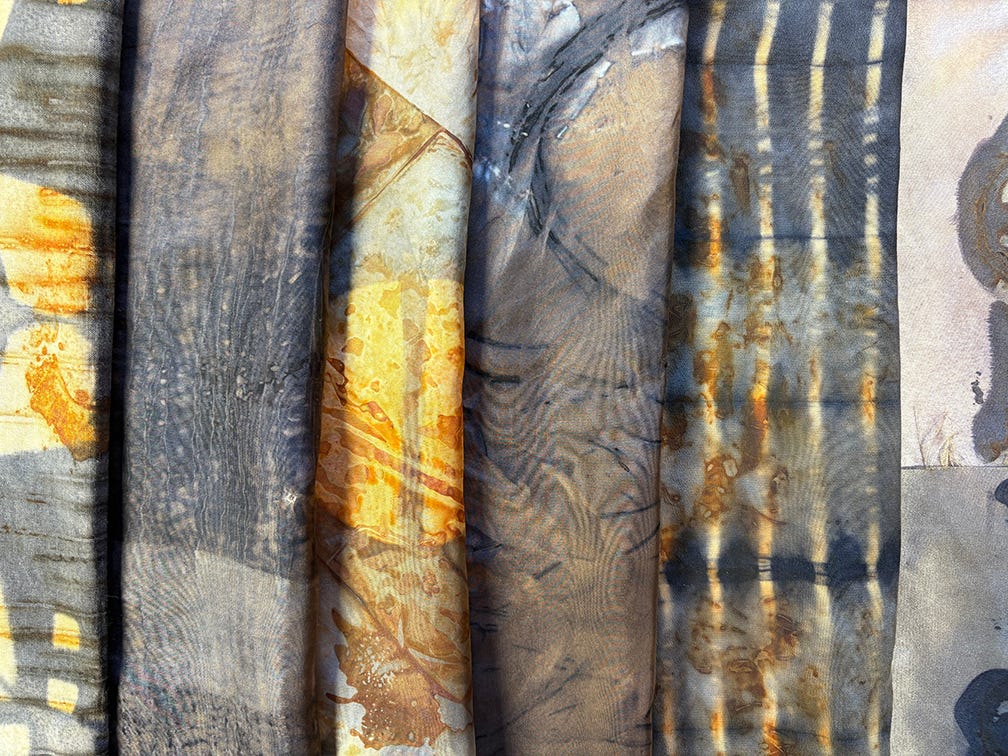
When you hit a “doing” lull, it’s time to capture what you’ve learned. Last week I was able to finally share images of my rust printed pieces because my obsessive rust printing had reached a lull. I knew it was time to take photos, transfer them to my computer, and match them with copious note-taking in order for all my learning thus far start to truly sink in. This literally took me hours.
It’s easy to feel like this is a waste of time because you’re no longer making anything. But taking that time to gather your thoughts is an integration process. A way of embodying what you’re learning rather than just exposing yourself to something.You’re always in a dance between the doing and the receiving.
Watching a demo or reading instructions is only half of learning—the receiving half. No matter how detailed or complete the information might seem. No matter how carefully you paid attention.
Learning something new is like sprinkling a fine powder on the top of the water bucket of your brain; at first, it all just floats there. To internalize that information, you must stir that fine powder until it actually dissolves and becomes a part of your body. But this stirring isn’t just the “doing” part of learning—it’s the dance between the doing and receiving. You watch/read a lot, then do a little, then realize you need to watch/read again. Then, it’s do-watch-do. Do-read-do. Bow to your partner. And just as you’re getting tired of stirring, suddenly, it’s a part of you.There will always be dead ends.
As you learn something new, you will probably spend a considerable amount of time doing something—perhaps creating something very good—that you realize you must abandon. This is actually a part of the learning process and the creative process. Every week, for instance, I delete wonderful paragraphs I have labored over in the writing of this newsletter. It can be a painful goodbye. But those lovely paragraphs fell on their swords so I could figure out what I really wanted to say. Adieu sweet princes, I loved you so.Conversation helps.
My husband and I often tell each other about our respective struggles with what we’re working on even though neither of us knows much about the other’s field of interest. But clarity often comes just from the effort it takes to explain your struggle to another person. Or when they don’t get it and ask questions that makes you say, “No, no, not that, but this.”
And speaking of questions, a good question to an expert can take you far—not so much because you get to receive their expertise, but because it helps you articulate what exactly you don’t understand. It takes you out of the fuzziness. As a bonus, it also helps you realize how much you’ve actually already absorbed.Learning requires faith.
In order to learn, you have to be willing to let yourself get good and lost. To do that, you have to have faith in your ability to find your way back to yourself again.
I’ve become a better student over the course of my life because I’ve become a better artist over that time. I have faith that I can work my artistic problems out, even when I’m groping around in the dark making mistakes with yet another new material. That faith gives me the courage to experiment—because I know my experiments aren’t evidence in a jury trial of whether I’m a good artist or not.Deeply learning anything is a form of intimacy with life itself.
When you do a deep dive with something, you’re no longer superficially engaging the universe with casual small talk. You’re connecting on a soul level. It can be subtle and hard to articulate, but it’s deeply satisfying. It’s like the difference between planting something from seed and buying the seedling from the nursery. I do both, of course, but when I start a seed indoors and harvest the flower or vegetable ninety days later, it creates a kind of wordless intimacy to the gardening experience that makes me feel alive.
Really, of all the bullets in my list, it’s that intimacy—the being-there-for-all-of-it—that serves up the deepest gratification. Growing things, learning things, and creating things—they’re all a way for me to partner with the universe.
I don’t want to casually wave at life across a large auditorium. I want to hug it close and tell it I love it. And learning how to do something well is one way to do that.
P.S. The next Creative Change Maker’s Zoom call is tomorrow, Wednesday, March 4 at 9am Pacific, 10am Mountain, 11am Central, and Noon Eastern. If you’re a paid subscriber, it’s free and you can register using the link at the top of your email.
If you’re a free subscriber and want to join us, we’d love to have you. An annual subscription is only 36.00 (3.00 a month) or you can sign up for a single month for a wee bit more. Use the link below to view your options!
Sarah, you are showing us how to live one’s life to the fullest. It’s a great lesson. Being brave enough to be new at things, to do things badly, to try to figure out things, instead of just stagnate or accept that we have already learned whatever we are going to learn. Love seeing the photo at the outset of the piece.
2 is a big one for me